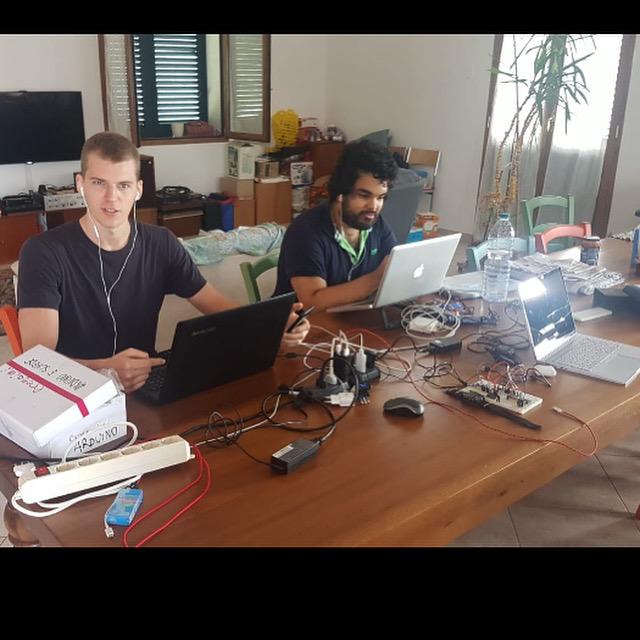
After graduating from high school in 2017, I enrolled in electronics engineering at Politecnico di Milano.
Thanks to it, I started getting a deeper understanding of what I'd been doing for ages with electronics — but without really knowing why it worked.
Analog electronics
I found the physics of Maxwell's equations, and its applications to electronic devices like transistors and antennas, fascinating — so I decided to specialize in analog electronics.
The commuting years
Throughout the three years of studies, I lived in Milan only for half of the time, while for the rest I commuted back and forth from Como. Life was pretty tough and monotonous: I was spending most of the day in class, and the rest of the time I was commuting really early in the morning or late in the evening.
Away from practice
Politecnico was a great place for studying, but there wasn't a lot of opportunity — nor time — for getting your hands dirty turning theory into practice. As I was learning more and more about the underlying theory of electronics (mostly math and physics), I unfortunately got more and more detached from the practice of building cool things.
Complexity theory and emergence
Besides this, during the last year of my bachelor I became fascinated by complexity theory and the phenomenon of emergence. Books like A New Kind of Science, Complexity, and Gödel, Escher, Bach completely changed how I see the world.
The fact that simple inanimate objects interacting with each other can give rise to complex structures with emergent properties led me to realize that, after all, the human brain — and consciousness itself — might only be the result of many neurons interacting with each other (no secret sauce).
Discovering neuromorphic computing
This is when I found out that many people had been trying, for a long time, to create artificial brains. Reading books like Ray Kurzweil's How to Create a Mind and Jeff Hawkins' On Intelligence eventually led me to find out about the work of Carver Mead, the father of neuromorphic computing.
Neuromorphic computing is a subfield of analog electronics with the goal of creating devices that can mimic the functions of neurons — and, eventually, the brain. Its biggest advantage compared to traditional machine learning is that neural networks built with analog devices are much more energy efficient.
Neuromorphic engineering became the first thread tying together multiple of my interests: analog electronics, complexity theory, and neuroscience.
The ETH decision
This is how I decided to move to ETH Zurich for my master's, to specialize in neuromorphic computing under the supervision of Giacomo Indiveri. ETH was also famous for having amazing labs, which could help me bridge the gap between theory and practice that I had been missing during my bachelor.
Back to building
As soon as Covid freed up some time by eliminating the commute to university, me and a few friends started working on Omnia. By the time of our (online) graduation ceremony, we were back at building stuff full speed.